
 The birth of a child is a very special moment for a couple, bringing joy and special moments for the family.
This child will grow and some day will become an active citizen in the society. In the previous video, we have learned about pregnancy, childbirth and vaccination, and in this video we will approach on children’s education planning. In this website there is a full range on educational system in Japan.
1. Educational system in Japan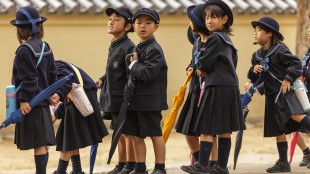
The Japanese educational system consists basically of 6 years of elementary school, 3 years of junior high school, 3 years of high school and 4 years of higher education (2 years in the case of short- period courses offered by colleges).
In Japan, education is compulsory for children of elementary and junior high school age, and all them should enroll and graduate from these schools. Foreign children aged 6 to 15 living in Japan can enroll or be transferred for elementary and junior high schools in the region of their residence.
2. Education expenses (Data from the survey by Ministry of Education, Culture, Sports, Science and Technology)
| School | Public | Private |
| Kindergarten (3 years) | ¥ 660,000 | ¥ 1.610.000 |
| Elementary School (6 years) | ¥1,820,000 | ¥8,810,000 |
| Junior High School (3 years) | ¥1,380,000 | ¥3,840,000 |
| High School (3 years) | ¥1,180,000 | ¥2,760,000 |
| College (4 years) | ¥2,630,000 | ¥5,270,000 |
| Total | ¥7,670,000 | ¥22,290,000 |
 Total amount since the first years of school until finish higher education is pretty high. And, for that, it is necessary to make a saving. In addition to education expenses (1 child) until he/she finishes college, there are other expenses, such as renting an accommodation and daily expenses (enrolment, PTA fee, scholar materials, tours) among others. And other additional expenses may surge according to each family, such as clothes, mobile phones, electronic games, etc.
3. Planning for the future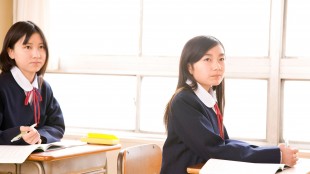
In Japan education is compulsory until the children finishes junior high school, and more than 98% of the students continue to study, and consequently those who enter higher education (university, college, specialized, vocational) adds up more than 70%. (Data survey by Ministry of Education, Culture, Sports, Science and Technology in 2015)
Check out the link below more details on higher education systems.
 In the future, the field of work your child plans to engage in is strictly connected to the type of education he/she attends today. In Japan, to engage in a field of work, qualified people are more requested. And it is not possible to get most of these qualifications by just finishing the high school. It is one of the reasons most of students continue to study, going forward higher education.
Check out on the link below a multilingual career guide for foreign students that can be useful to choose a field of work.
URL: http://www.pref.mie.lg.jp/TABUNKA/HP/49135032696.htm
Without a career planning is impossible to elaborate an education plan for your children. Before deciding on a profession, it is very import to discuss about this subject with members of the family, allowing the student to express his/her opinion on the field of work he/she plans to work in the future.
4. Student loan and help desk
When in trouble to save money for the education expenses of your child, in Japan there are several systems of funding and student loans. For more details, consult the school your child is attending or seek the education office in the region you live.
If the child attends a Japanese school and the financial condition of the family is not stable, a condition that does not enable the child to go forward the studies, there are some subsidy systems and scholarships.
See more details on scholarships as well as help desk in the link below:
URL: http://mieinfo.com/videos/educacao-videos/balcoes-de-atendimento-e-bolsas-de-estudos-emprestimos-estudantis/index.html
※ These information have been elaborated 2 years ago, therefore, they may contain outdated data regarding the sectors or outlined links.
 Final
Final
Make your child a model citizen in the society is the final goal of education. In order to your child becomes a member of the society, having a profession is a very important step. Students have the opportunity to choose from several career options, but in Japan there are many qualifications to acquire. For each field of work there are required qualifications and for some of them it is necessary to have a school record.
It is important the student’s goal is shared with the family, for the planning and the amount of education expenses be understood by everyone. And it is necessary the savings be made based on this planning.
Young people’s goals are changeable. Working in the desired field is a dream young people nourish from an early age, but as they grow, goals become more defined. It is recommended to talk to them from time to time and according to their development for the dreams and goals are shared with the family.
When questions related to children education come up, or you do not know how to solve a related problem, seek the education office of the region you live or a help desk for foreigners in the local city office, or contact the education counseling service offered by the prefectural education offices, as well as Mie Prefecture Gaikokujin Help Desk, among others.
[Source]
Ippan Zaidan Hojin Jichitai Kokusaika Kyokai Tagengo Seikatsu Jyoho (Counsel of Autonomous Bodies for Internationalization)